
Inventory segmentation & availability
Tier 1 companies like Amazon and Walmart have set the bar with endless inventory and rapid delivery. Stockouts, backorders and inventory errors lead to a direct loss in customer trust
Forget fragmented order management for frictionless omnichannel execution. Whether you're a B2B powerhouse, a 3PL innovator or a fast-growing retailer, Infios Order Management (OM) gives you the precision, adaptability and intelligence to meet consumer demand at any scale.
Infios Order Management is the orchestration layer of Intelligent Supply Chain Execution, powered by Infios AI™. It runs a continuous loop across your operation, sensing disruption early and deciding the optimal fulfillment path. Then it acts: rerouting orders, reallocating inventory and protecting delivery promises in real time—learning from every outcome to sharpen the next response.
It's a fundamentally different way to run order management.
Predictive AI protects inventory from stockouts and markdowns
Generative AI assists with integration from days to hours
Agentic AI resolves order exceptions with graduated autonomy
Conversational AI gives your team real-time visibility in plain language
Tier 1 companies like Amazon and Walmart have set the bar with endless inventory and rapid delivery. Stockouts, backorders and inventory errors lead to a direct loss in customer trust
Today’s buyers expect seamless experiences across all platforms. But subtle differences between B2B and B2C processes create friction and slow transactions
From global events to cyber threats, disruption is inevitable. Resilient, agile operations are no longer optional, they’re a competitive advantage
Giant companies like Amazon and Walmart have set the bar with endless inventory and rapid delivery. Stockouts, delays, and errors now cost more than revenue; they cost customer trust
Manual processes and siloed systems hold back growth. Streamlining operations - from warehouse to last mile - is key to scaling effectively
An OMS (Order Management System) is the engine of omnichannel, B2B and 3PL execution. It unifies inventory across warehouses, stores and partners, stopping oversells, slashing stockouts and backorders, and powering fulfillment at scale. From bulk, large line item B2B orders to rapid 3PL onboarding, it turns complexity into profit and promises into performance.


Infios Order Management (OM) slashes fulfillment costs with advanced analytics and ML-powered decisioning, routing every order to the smartest, most profitable node. It powers seamless omnichannel and B2B commerce, from bulk shipments to just-in-time replenishment, while enabling agents to deliver service that builds loyalty and keeps customers coming back.
Infios Order Management has been strategically designed to ensure every component of the platform is scalable, modular and optimized for growth—whether you're managing spikes in demand, expanding into new channels or integrating with evolving tech stacks. Each module can be implemented and bought individually.

Our modular solution easily connects into your tech stack to reduce risks and lower the total cost of ownership - no rip and replace required. Scalable and proven, it grows with you, turning B2B complexity into opportunity and big ambitions into repeatable wins.
Unified Order & Inventory Management – Real-time visibility across warehouses, stores, marketplaces and suppliers.
Dynamic Fulfillment Intelligence – Optimize costs and speed with AI-powered order routing & allocation.
Seamless Integrations & Adaptors – Effortlessly connect with ERP, WMS, CRM and e-commerce platforms.
B2B & 3PL-Ready – Handle complex fulfillment, vendor management and multi-enterprise orchestration with ease.
Rapid Deployment, Fast ROI – Go live in 16 weeks (or less) and see measurable returns in 6-12 months.
Order Management for 3PLs
Order Management for B2B
Integration Platform As a Service (iPaaS)
Our AI agents handle the order work that usually backs up your team, from launching channels to cancellations to customer questions. Your team stays in control of every decision.


AI helps Infios OMS make better decisions automatically, like choosing the best fulfilment node, improving delivery promises, spotting risk earlier (inventory shortfalls, capacity issues, carrier delays), and flagging anomalies. With the AWS collaboration, Infios is also building agentic capabilities such as conversational workflow creation (for example, describing a new channel setup in natural language and having AI generate the workflow) and AI copilots that monitor and recommend fixes within defined guardrails.
Intelligent Supply Chain Execution connects OMS, WMS, and TMS into a shared intelligence layer. In that model, OMS acts as the orchestration “brain”, making fulfilment decisions with real-time awareness of warehouse capacity and transport constraints (not just inventory). This reduces firefighting, improves promise accuracy, and enables faster, co-ordinated responses when conditions change, like warehouse delays or transportation cost spikes.
Yes. Infios OMS supports both high-velocity B2C and complex B2B requirements in one platform. B2C capabilities include omnichannel fulfilment, marketplace and e-commerce integrations, and subscription workflows. B2B capabilities include large line counts, customer-specific pricing and terms, allocation rules, and more complex ordering and fulfilment logic. The modular setup lets organisations turn on what they need without maintaining separate systems.
Infios OMS is designed for faster deployments than traditional enterprise projects. Typical go-live can be 4–16 weeks depending on scope. ROI often appears within 6–12 months. Speed comes from modular delivery and implementation, pre-built connectors, an embedded integration layer, and no-code configuration with AI workflows, so teams can add capabilities without a full “rip and replace”.
An OMS has proved hugely beneficial for most retailers, wholesalers, manufacturers and 3PLs in the rapidly evolving commerce landscape of the last five years. However, high-volume enterprise retailers and brands with complex fulfillment operations or omnichannel requirements require best-in-breed order management software to create a seamless customer experience and improve operation efficiencies.
An Order Management System (OMS) is a technology platform that coordinates all the essential aspects of a purchase, including exposing inventory, processing the order, determining the best path to fulfillment, trigger of payment processing, notifications and servicing the order.
It spans the entire order lifecycle, including inventory availability, order receiving, order routing, data exchange, fulfillment, tracking, shipping notifications, alerts and potential modifications or appeasements of orders.
An OMS and an ERP do different jobs, but work best together.
An ERP manages core business operations: finance, procurement, HR, inventory, and manufacturing. It's the system of record for the business and is used across multiple departments to manage resources and reporting.
An OMS manages order fulfilment: inventory allocation, order routing, warehouse and carrier co-ordination, order changes, exceptions, and delivery performance.
In short, an ERP focuses on managing the business as a whole, while an OMS focuses on getting orders delivered correctly and on time. When integrated, the ERP provides foundational data, such as inventory positions, pricing, and customer records, while the OMS handles the execution layer, sending back real-time order and delivery updates to keep business-wide reporting accurate.
Whitepaper
Explore what brands and retailers need to know about Order Management Systems (OMS)

Ebook
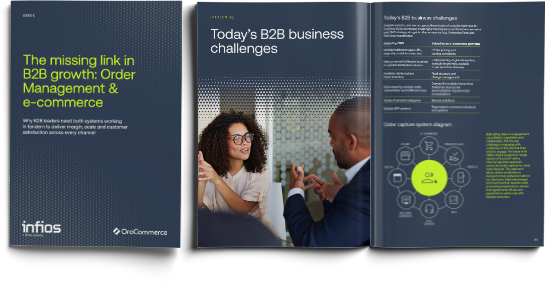
Why B2B leaders need both systems working in tandem to deliver margin, scale and customer satisfaction across every channel
Blog
How AI is transforming order management - improving fulfillment speed, accuracy and customer satisfaction

Explore what brands and retailers need to know about Order Management Systems (OMS)
Why B2B leaders need both systems working in tandem to deliver margin, scale and customer satisfaction across every channel
How AI is transforming order management - improving fulfillment speed, accuracy and customer satisfaction


Worldwide AI-Enabled Order Orchestration and Fulfilment Applications for B2B and Manufacturing 2026 Vendor Assessment.


