


-
7%increase in PM Quality resulting in fewer shop visits for our customers
Built for logistics service providers (LSPs) managing customer commitments, operational variability, warehouse throughput and high-velocity transportation across fast-moving networks.


Service levels, order profiles, or customer demand suddenly change, so teams need to decide which work to prioritize first across the network.

Inbound volume, order mix or customer requirements shift, so teams need to decide how to redirect labor and warehouse activity to protect throughput.
Disruptions start to pile up across carriers, shipments and customer commitments, so teams need to decide where to step in first to reduce service impact.
Penske
Garden State Cold Storage
Running multiple customers across one network raises the bar for what counts as a real execution solution, not just a monitoring layer. Our checklist for evaluating an AI supply chain execution solution walks through what separates the two.
When one customer's service level shifts, it shouldn't take a phone call for your team to notice. Infios AI works inside the systems that run your whole network, so it can open a dock earlier or shift a crew to cover the gap for that customer, without pulling your team off another customer's work to do it.
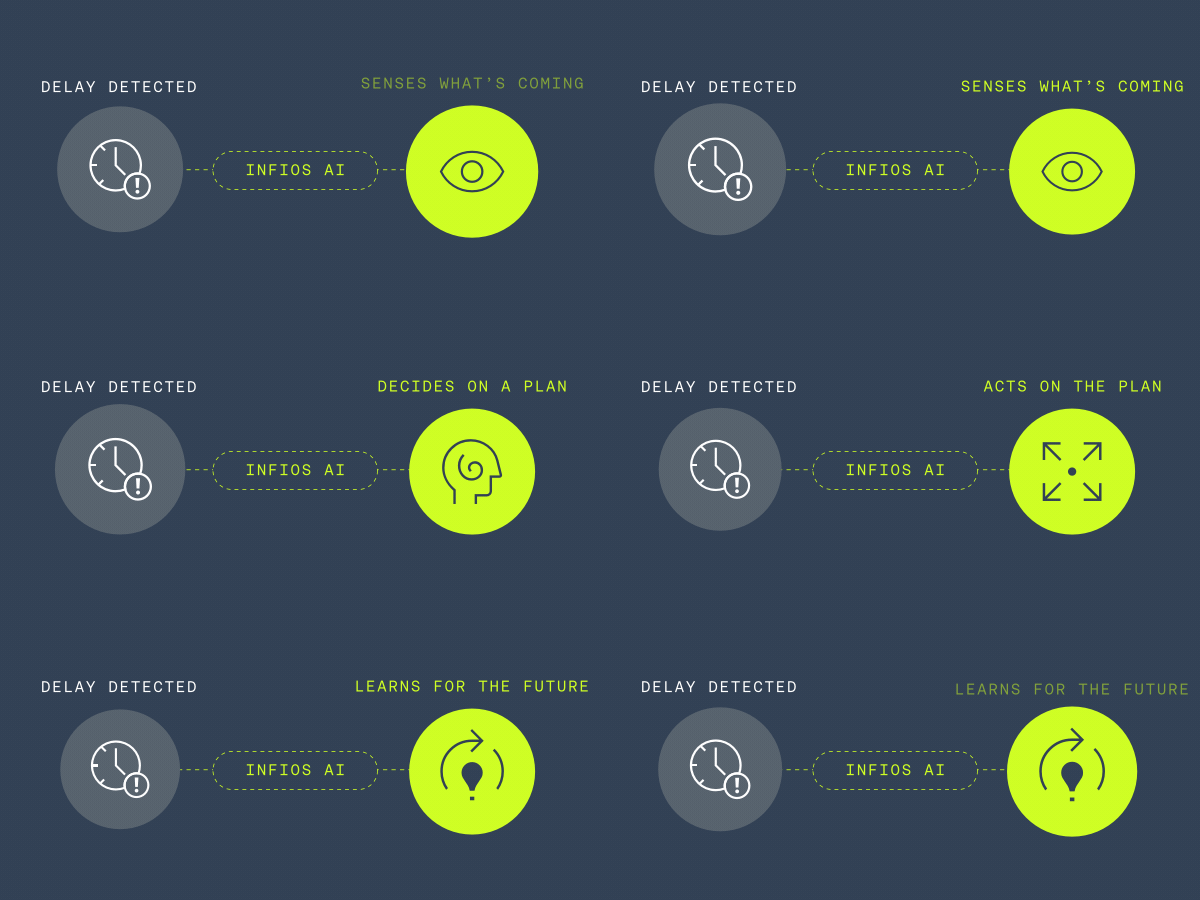
Predictive, generative, agentic and conversational AI work together across the network: sensing which customer or lane is at risk early, deciding what to prioritize, reallocating labor or a dock slot to the customer that needs it most and getting better at reading each customer's patterns with every shift.
LSPs don't need to standardize every customer's workflow on day one. Driver Status Update agent is often the first move: Infios AI calls drivers automatically for status and ETA and updates the TMS directly, instead of a dispatcher chasing that information down one carrier at a time, which matters when you're scaling across customers without adding headcount. From there, autonomy can expand across the rest of the network.
Not every customer wants the same amount of autonomy, and Infios AI doesn't assume they do. Teams apply their own approval rules by customer or contract, keeping a person in the loop for an account that needs it, like a service failure on a high-priority customer, while it acts independently everywhere that trust already exists.


annual transportation cost savings


