

- Blog
5 min
Why your WMS may be the weakest link in your supply chain
Discover how AI-enabled Warehouse Management Systems (WMS...


Warehouse leaders are accelerating modernization plans as they navigate rising operational pressures, labor constraints and growing expectations for speed and accuracy. Drawing on findings from Zebra’s Warehouse Vision Study, this blog explores where warehouses are prioritizing investment heading into 2026—from foundational automation and visibility tools to advanced AI-enabled software—and how approaches differ based on each operation’s level of maturity. No one in the warehousing industry needs anyone to tell them that the industry continues to undergo massive transformation and that it’s facing huge challenges in how to operate more efficiently, effectively and at more manageable costs.
So, it’s perhaps no surprise that, heading into 2025, 70% of warehousing decision-makers were already facing modernization mandates. In fact, 64% of warehouses planned to increase funding over the next five years to carry out those mandates. Those are two of the most crucial numbers that came out of Zebra’s 2024 Warehouse Vision Study.
Also not surprisingly, 87% of the same decision-makers agreed that investing in technology was essential to meeting those modernization goals. But not all warehouses are at the same stage of evolution in their operations, and they’re not all facing the same challenges in where they are today versus where they need to be over the next several years.
Some warehouses are already digitized and more automated, so they’re looking at more advanced strategies, such as investing in AI-enabled software to help them improve performance, workflows and maintenance. In fact, 65% of warehouses have already started or plan to do that over the next five years.
Additionally, 61% of all warehouses plan to invest in software to help automate their analytics and decision-making, so they can turn the data they collect from their frontline processes into more informed and strategic decisions to help manage inventory, workflows and resources.
But some warehouses are still at an earlier stage of modernization, or they still have gaps to fill in their efforts to digitize and modernize. Most still need to automate workflows (61%), increase visibility across the supply chain (62%), invest in better inventory and asset visibility in the warehouse itself (59%), and improve and prioritize labor optimization (59%).
Crucially, another finding from Zebra’s Warehouse Vision Study is that 63% of warehouse decision-makers plan to accelerate the timelines of modernization projects.
So, if you’re sitting on the fence or simply working on a plan you’ve already put in place, it might be time think about accelerating your plans and efforts—especially if you’re looking to keep up with competitors.
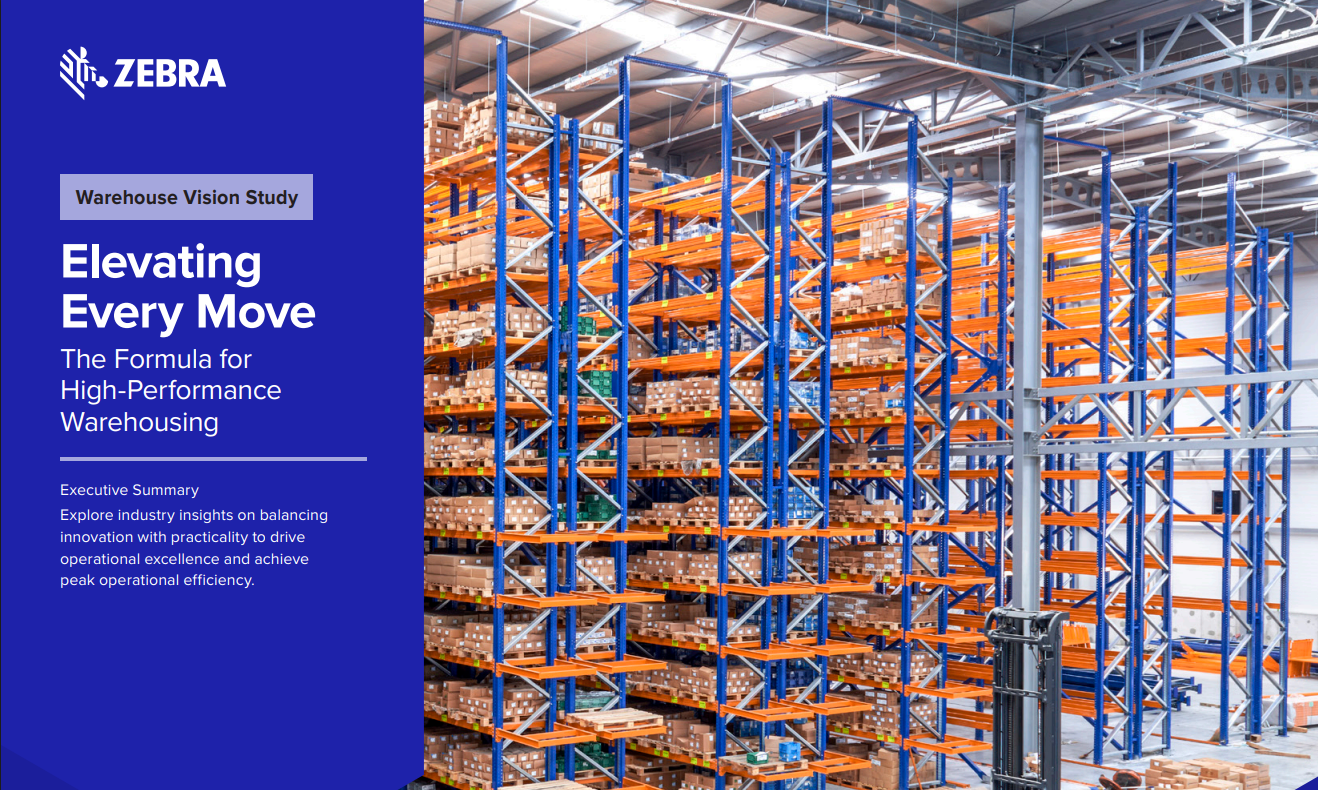
Given the different stages of modernization and the different optimization strategies that warehouses have been pursuing, the one unifying factor is technology—whether your warehouse is still building up more of its fundamental automation, labor optimization, and inventory visibility capabilities, or you’re already at an advanced stage where it’s time to turn your data, visibility and analytics into AI-driven optimization and enhanced decision-making.
For example, hundreds of warehouses are already fully digitized but have been equipping their teams with more modern devices such as wearable mobile computers and voice-directed technologies, to help them complete tasks even faster and more accurately with hands-free efficiency.
Others have already equipped their teams with more efficient and optimal devices, so they’re pursing more advanced automation strategies, such as integrating vision sensors at dock doors, on conveyor lines, and at packing benches, to automate scanning, tracking, traceability, dimensioning and visual inspections in their logistics and shipping processes.
In other cases, warehouses are looking to adopt AI into their workflows and create a central intelligence layer. These solutions can help teams gain clearer visibility into operations, analyze performance trends and surface opportunities for improvement. With greater insight and earlier detection of potential issues, warehouses are better positioned to streamline fulfillment and strengthen overall supply chain execution.
Overall, the industry is also looking to leverage software AI and analytics to empower better warehouse excellence. In fact, 65% of warehouses are planning to implement software for predictive analytics, and 57% are planning to implement machine learning that uses algorithms to learn from their data, identify patterns, make predictions, and even recommend and make decisions.
These are just a few examples of innovations that all warehouses and busy logistics hubs should be considering as part of their modernization and automation efforts. But, as you’re thinking about how and where to invest in the coming years, you also need to keep an eye on your frontline as one of your best guides toward potential improvements.
As you evaluate and prioritize your options, though, it’s also crucial to understand the challenges, priorities, and opportunities from your frontline associates’ standpoint.
The good news is that 91% of warehouse decision-makers involve associates in decisions related to automating workflows and modernizing their warehouses. But, in many cases, decision-makers still don’t do enough to truly understand the day-to-day difficulties and challenges that workers are really facing.
It’s one thing to seek input or seek buy-in for proposed changes to warehouse workflows or the technologies that workers will be using. But it’s another thing to truly be in their shoes, to do the job, and to struggle with the same challenges or missed opportunities that decision-makers might otherwise overlook.
This is where your frontline workers can be one of your best strategic assets, as they often know better than anyone what your challenges and opportunities truly are. While not every recommendation will be the right choice or make the right business sense, they often have some of the best ideas for process improvement, how to optimize workflows, and what they need to make that possible.
AI-driven software tools can also help you analyze the data that they’re collecting and that you’re gathering from their frontline processes every day, to further identify your best opportunities and needs for automation and improvement.
But your associates can be your key informers, to help guide your modernization plans and priorities—even when it comes to automation and AI. We often assume that workers generally see technology or AI as a potential enemy or a threat. But, according to Zebra’s Warehouse Vision Study, 89% of warehouse associates feel more valued when they’re provided with technology tools and automation.
In fact, 74% report spending too much time on tasks that could be automated, and 90% of warehouse associates agree that the first and best way to introduce and increase automation is to augment labor with technology and devices.
So, before you assume that investments in automation, AI and modernization might be met with resistance, talk to your associates and bring them into your planning and decisions. You might be surprised at how much they can be an ally in moving your operations forward.
When they can contribute and be a part of using automation and AI to help them make their jobs easier, to work more efficiently and effectively, and to focus on more value-added and less tedious tasks, they can be among your biggest supporters and help ensure the success of your eventual adoption and rollout.
Hopefully the quick stats, industry insights and the tips we’ve shared will get you thinking more about your warehouse modernization efforts, where you need to prioritize and give you some inspiration on specific investments and improvements you can make.
For deeper insight into Intelligent Supply Chain Execution and practical recommendations for different operational challenges, you can explore additional resources and more specific recommendations that might be an ideal fit for your unique challenges and opportunities, feel free to check out Infios Knowledge Center or connect with the team for industry perspectives. As an expert in Intelligent Supply Chain Execution, Infios helps warehouses create more automated, efficient and AI-driven processes every day.
Discover how AI-enabled Warehouse Management Systems (WMS...

